8 Ways Digital Transformation Is Boosting Sales ROI in Retail & Ecommerce - And Why Delay Is Costing You Millions
Key Takeaways
What You Will Learn From This Article
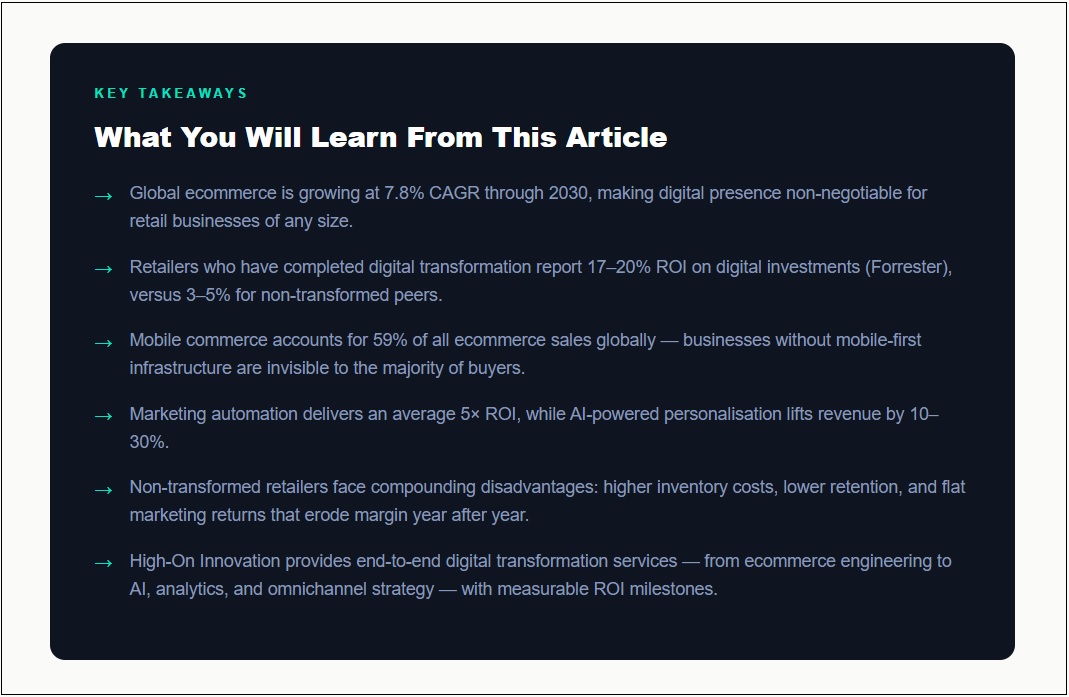
Global ecommerce is growing at 7.8% CAGR through 2030, making digital presence non-negotiable for retail businesses of any size.
Retailers who have completed digital transformation report 17–20% ROI on digital investments (Forrester), versus 3–5% for non-transformed peers.
Mobile commerce accounts for 59% of all ecommerce sales globally — businesses without mobile-first infrastructure are invisible to the majority of buyers.
Marketing automation delivers an average 5× ROI, while AI-powered personalization lifts revenue by 10–30%.
Non-transformed retailers face compounding disadvantages: higher inventory costs, lower retention, and flat marketing returns that erode margin year after year.
High-On Innovation provides end-to-end digital transformation services — from ecommerce engineering to AI, analytics, and omnichannel strategy — with measurable ROI milestones.
Introduction
The Digital Imperative Has Arrived — and It Cannot Wait
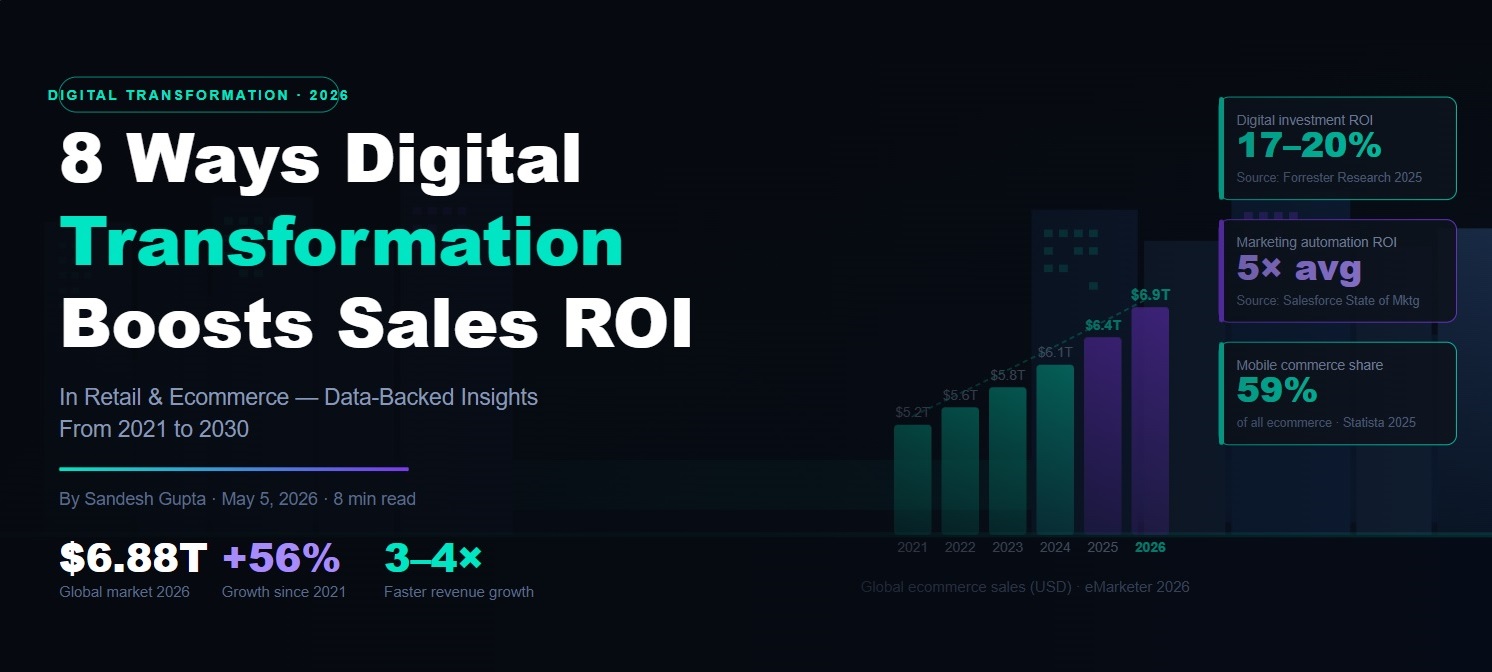
In 2021, global retail ecommerce sales stood at $5.2 trillion. By 2026, that number is forecast to reach $6.88 trillion — a 32% surge in just five years. By 2030, projections indicate the market will approach $8.91 trillion, according to eMarketer. Ecommerce is no longer a supplementary channel. It is the primary battlefield where retail revenue is won or lost.
Yet, despite these numbers, a significant portion of retail businesses continue to operate on legacy systems, manual processes, and fragmented digital strategies — watching competitors pull further ahead with every passing quarter. The question is no longer whether to undergo digital transformation. It is how fast you can execute it before the performance gap becomes irreversible.
This article presents a data-backed case for digital transformation in retail and ecommerce — grounding the conversation in verified global trend data from 2021 to projected growth through 2030, and drawing a clear line between the businesses capitalizing on digital investment and those being left behind.
Global Data Trends · 2021–2030
The Numbers Don't Lie: A Decade of Ecommerce Dominance
To understand the urgency of digital transformation, one must first understand the scale of the market shift occurring beneath every retailer's feet. The following table presents verified ecommerce growth data from 2021 through to projected figures for 2030.
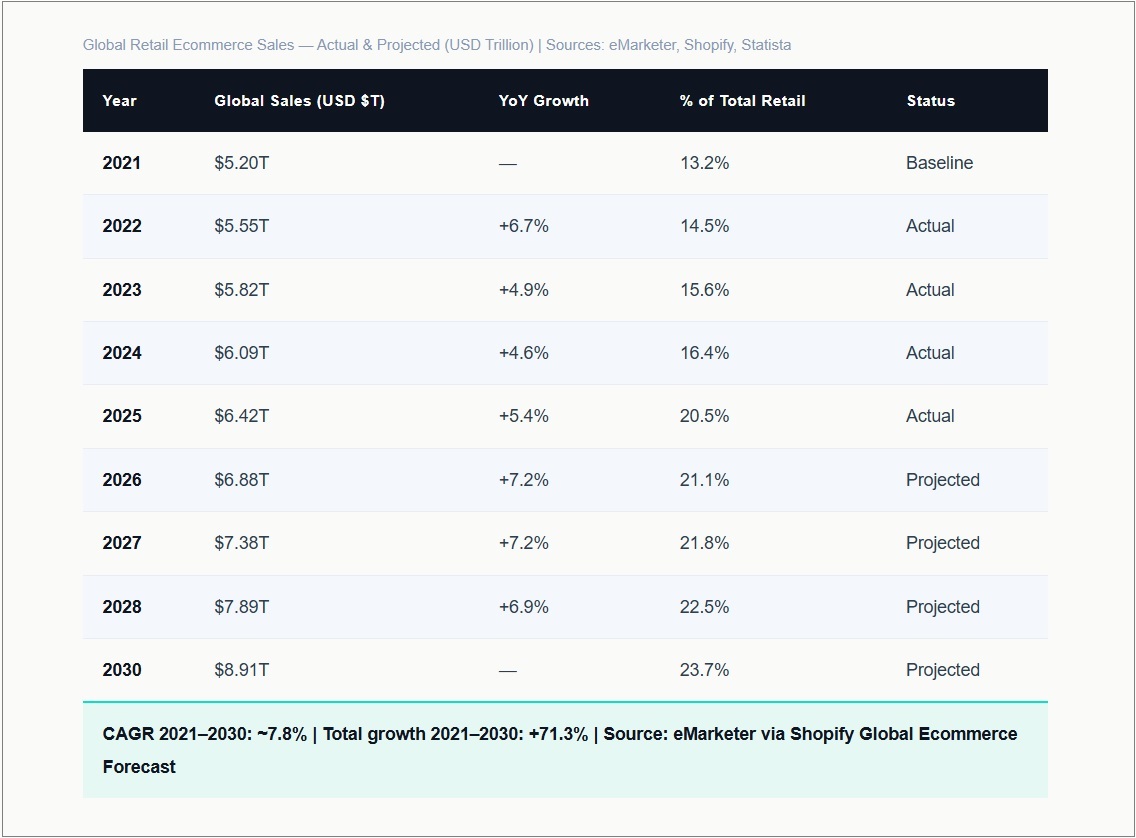
The trajectory is unambiguous. By 2026, ecommerce will account for 21.1% of all global retail sales — the highest share ever recorded. By 2030, nearly one in four dollars spent in retail will be spent digitally. Businesses that are not positioned to capture this shift will, by mathematical reality, be capturing a shrinking share of a growing market.
Detailed Analysis
6 Reasons Retail Businesses Cannot Afford to Delay Digital Transformation
01 Ecommerce Is Growing Twice as Fast as Physical Retail
Global ecommerce is expanding at more than double the rate of brick-and-mortar retail. While physical retail sees modest single-digit growth, ecommerce is rebounding strongly toward 7–8% annually through 2030. Retailers without a robust digital storefront are structurally excluded from the fastest-growing segment of the consumer economy.
$6.88T ecommerce market by 2026 (eMarketer)
02 Personalization Is Now a Purchase Driver, Not a Feature
According to Salesforce and Epsilon research, 80% of shoppers are more likely to buy from brands that offer personalized digital experiences, and 67% say personalization actively influences their purchase decisions. AI-driven recommendation engines and dynamic content are no longer differentiators — they are baseline consumer expectations. Online retailers implementing personalization are seeing revenue uplifts of 10–30%.
+10–30% revenue from AI personalization
03 Mobile Commerce Has Become the Dominant Sales Channel
Mobile commerce generated $2.51 trillion globally in 2025, accounting for 59% of all ecommerce transactions (Statista). In markets like South Korea, mobile devices account for over 75% of all online sales. Retailers without a mobile-optimized, fast-loading, frictionless purchase experience are effectively invisible to the majority of global online shoppers — particularly those aged 18–44, the highest-spending demographic.
59% of all ecommerce via mobile (Statista, 2025)
04 Automation Delivers Immediate and Compounding Cost Savings
McKinsey estimates that companies adopting digital tools and automation can reduce operational costs by 15–20%. Accenture projects that retail digital transformation will deliver $1.3 trillion in global cost savings by 2030. Inventory management alone, when paired with RFID and AI demand forecasting, has shown 50–70% reduction in inventory inaccuracies (per IBM Retail Industry Report). Retailers using marketing automation report an average return of 5× on their marketing investment.
15–20% cost reduction from automation (McKinsey)
05 Data Intelligence Is the New Competitive Moat
The retail businesses pulling ahead are not necessarily the largest — they are the most data-intelligent. By investing in customer data platforms, real-time analytics, and AI-driven demand forecasting, digitally transformed retailers can predict demand, reduce returns (which cost retailers an estimated $816 per second globally in 2023), and optimise pricing dynamically. This creates a compounding advantage that manual operations simply cannot replicate.
$18.8B spent on AI retail tech in the US in 2024
06 Social Commerce and Emerging Channels Are Exploding
Social commerce — purchasing directly via social platforms — grew 19.9% globally to $819.8 billion in 2025, with more than 50% of US social media users having made at least one social purchase. Live commerce, AR try-ons, and voice shopping are rapidly becoming mainstream. Retailers who have not integrated these channels into their digital strategy are surrendering high-intent traffic to competitors who have.
$819.8B social commerce globally in 2025
Strategic Importance
Why Digital Transformation Is the Most Important Investment a Retailer Can Make Right Now
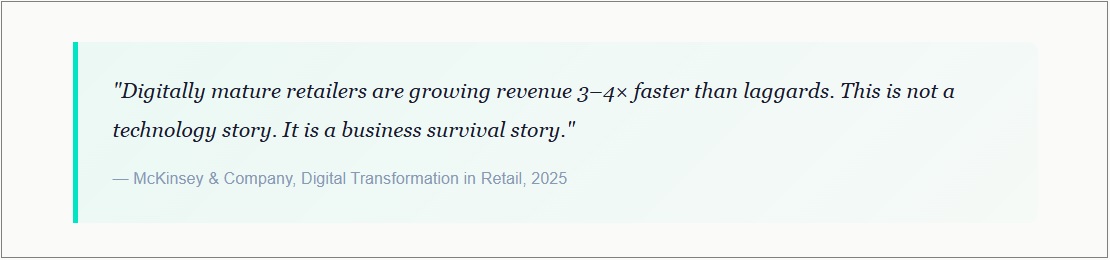
The importance of digital transformation in retail goes beyond revenue metrics. It is a structural repositioning of how a business creates, delivers, and captures value. The retailers who invested in transformation through 2021–2025 — building omnichannel infrastructure, adopting AI, and migrating to cloud-native platforms — are now operating from a position of compounding advantage.
Forrester Research found that companies with sophisticated digital strategies see an average ROI of 17–20% on their digital investments. Target's widely cited transformation, which began in 2017, saw same-day digital services grow 90% in 2021 alone, reducing delivery costs by 90% by fulfilling from stores rather than centralized warehouses. This is the compounding effect of transformation: early investment creates infrastructure that becomes exponentially more efficient over time.
The retail sector is also facing mounting pressure from consumer expectations shaped by digital-native brands. When Amazon sets the standard for same-day delivery, personalized recommendations, and frictionless returns, every retailer — regardless of size — is judged against that benchmark. Digital transformation is the only credible path to meeting that bar.
Benefit vs Loss Analysis
The Stark Reality: What You Gain vs What You Lose
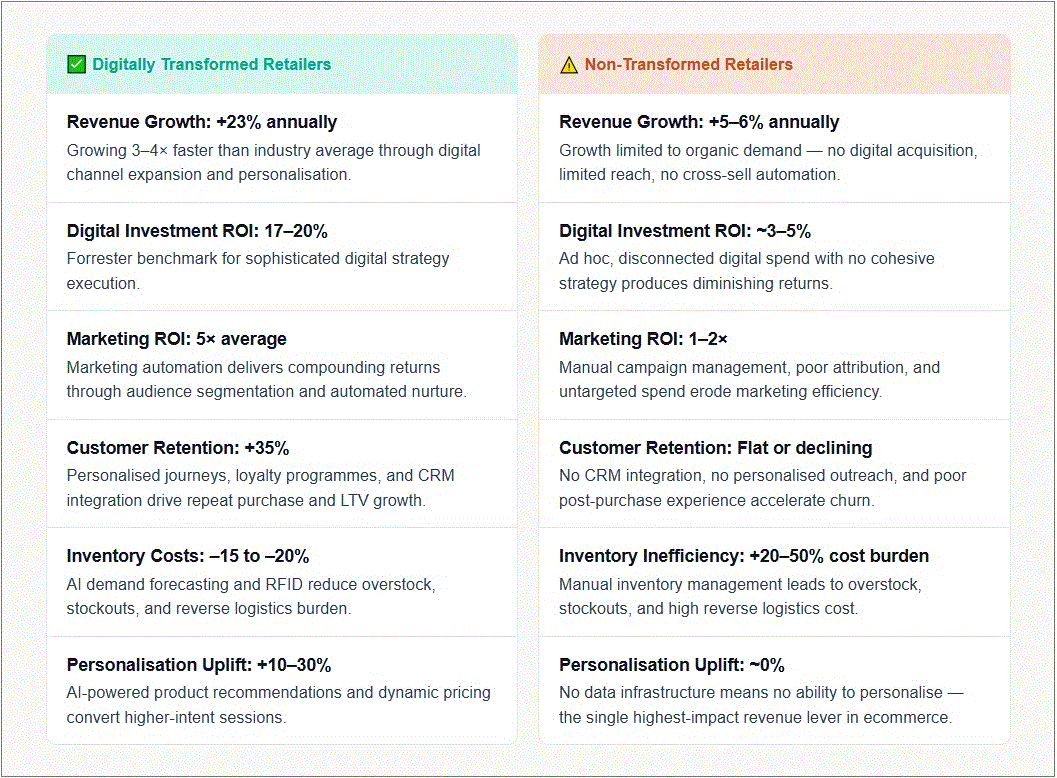
The performance gap between digitally transformed retailers and their non-transformed peers is no longer theoretical. It is measurable, verifiable, and widening every quarter. Below is a direct comparison across the key business metrics that determine long-term retail viability.
Conclusion
The Window Is Open — But It Is Closing Fast
The global ecommerce market will reach $6.88 trillion in 2026 and $8.91 trillion by 2030. Mobile commerce already accounts for 59% of all digital sales. AI personalization is delivering 10–30% revenue uplifts. Marketing automation is generating 5× returns. Retailers who have invested in digital transformation are growing revenues at 23% annually — while those who have not are stuck at 5–6%.
These are not projections or theories. They are audited figures from eMarketer, Forrester, McKinsey, Statista, and Accenture — the most rigorous research bodies covering the global retail sector.
The question for every retail and ecommerce business leader reading this is not whether digital transformation is necessary. The data has answered that definitively. The question is whether your organization will be among those shaping this new landscape — or among those being displaced by it.
The time to act is now. Not next quarter. Not after the next budget cycle. Now — because your competitors are not waiting, and the compounding advantages of early investment are already being captured by businesses that moved faster than you.
Author:
Sandesh Gupta (Tech Researcher & Writer · High-On Innovation)
Sandesh Gupta is a technology researcher and writer specializing in digital transformation, ecommerce strategy, and emerging retail technologies. With a focus on translating complex market data into actionable business intelligence, his work helps retail and ecommerce leaders make informed decisions about technology investment, digital strategy, and revenue growth. He contributes regularly to the High-On Innovation blog, covering topics at the intersection of innovation, commerce, and ROI.
Sources & References
eMarketer / Shopify — Global Ecommerce Sales Forecast 2021–2030
Sellers Commerce — Global Ecommerce Statistics 2026
Capital One Shopping Research — Ecommerce Statistics 2026
Backlinko — 36 Up-To-Date Ecommerce Statistics 2026
Number Analytics — 5 Stats Revealing Digital Transformation's Impact on Retail Ecommerce
Gitnux — Digital Transformation in Ecommerce Industry Statistics 2026
Contact Pigeon — Digital Transformation in Retail: Key Success Factors 2025
US Census Bureau — Quarterly US Retail Ecommerce Sales Q4 2025
McKinsey & Company — Digital Transformation in Retail, 2025
Forrester Research — The ROI of Digital Investments in Retail, 2023
Accenture — Retail Digital Transformation Cost Savings Report, 2024
Statista — Mobile Commerce Revenue Worldwide, 2025
Latest Market Trends

Apr 20, 2026
AI Automation vs Hiring in 2026: Which Strategy Helps Growing Businesses Scale Faster?
Key Takeaways
AI automation helps businesses scale faster by reducing repetitive manual work and improving operational efficiency.
Hiring is still essential for creativity, strategy, leadership, and customer relationships.
The smartest growth strategy in 2026 is not AI vs hiring, but AI + human talent working together.
Businesses that automate routine processes can reduce costs, improve speed, and free teams for innovation.
Companies that balance automation with strategic hiring build more scalable and resilient operations.

Mar 5, 2026
Digital Transformation Trends 2026: What Forward-Thinking Businesses Must Prepare?
2026 is not just another year in digital transformation it marks a turning point. For years, businesses experimented with AI, cloud, and automation. But now, the conversation has shifted from “What’s possible?” to “What delivers real results?”
Digital transformation in 2026 is no longer about adopting technology. It’s about embedding intelligence into the core of your business.
At High On Innovation (HOI), we see this shift clearlyorganizations are moving from transformation projects to continuous digital evolution. Let’s explore the key trends shaping this new era.

Feb 3, 2026
Enterprise Modernization Strategy: Reinventing the Core of Your Business for the Digital Age
Most enterprises don’t fail because they lack ambition.
They struggle because their systems, processes, and infrastructure were built for a different era.
While the world moves in real-time powered by AI, cloud, and data many organizations are still operating on legacy foundations that were never designed for speed, scale, or intelligence.
This is where enterprise modernization becomes more than a technology upgrade.
It becomes a business survival strategy.
At High On Innovation (HOI), we help enterprises move beyond outdated systems and step into a future defined by agility, intelligence, and continuous innovation.
Popular Post
AI Automation vs Hiring in 2026: Which Strategy Helps Growing Businesses Scale Faster?
Key Takeaways
AI automation helps businesses scale faster by reducing repetitive manual work and improving operational efficiency.
Hiring is still essential for creativity, strategy, leadership, and customer relationships.
The smartest growth strategy in 2026 is not AI vs hiring, but AI + human talent working together.
Businesses that automate routine processes can reduce costs, improve speed, and free teams for innovation.
Companies that balance automation with strategic hiring build more scalable and resilient operations.
Digital Transformation Trends 2026: What Forward-Thinking Businesses Must Prepare?
2026 is not just another year in digital transformation it marks a turning point. For years, businesses experimented with AI, cloud, and automation. But now, the conversation has shifted from “What’s possible?” to “What delivers real results?”
Digital transformation in 2026 is no longer about adopting technology. It’s about embedding intelligence into the core of your business.
At High On Innovation (HOI), we see this shift clearlyorganizations are moving from transformation projects to continuous digital evolution. Let’s explore the key trends shaping this new era.
Enterprise Modernization Strategy: Reinventing the Core of Your Business for the Digital Age
Most enterprises don’t fail because they lack ambition.
They struggle because their systems, processes, and infrastructure were built for a different era.
While the world moves in real-time powered by AI, cloud, and data many organizations are still operating on legacy foundations that were never designed for speed, scale, or intelligence.
This is where enterprise modernization becomes more than a technology upgrade.
It becomes a business survival strategy.
At High On Innovation (HOI), we help enterprises move beyond outdated systems and step into a future defined by agility, intelligence, and continuous innovation.

Digital Transformation Strategy Guide: Building Future-Ready Enterprises
In today’s fast-evolving digital landscape, businesses are no longer competing solely on products or services—they are competing on speed, intelligence, and adaptability. Digital transformation is no longer optional; it is a strategic imperative for organizations aiming to stay relevant, competitive, and resilient.
At High On Innovation (HOI), we believe digital transformation is not just about adopting new technologies—it’s about reimagining how businesses operate, deliver value, and grow in a digital-first world.
This guide explores how organizations can build an effective digital transformation strategy that drives measurable outcomes and long-term success.